


Nova Meja
Summary
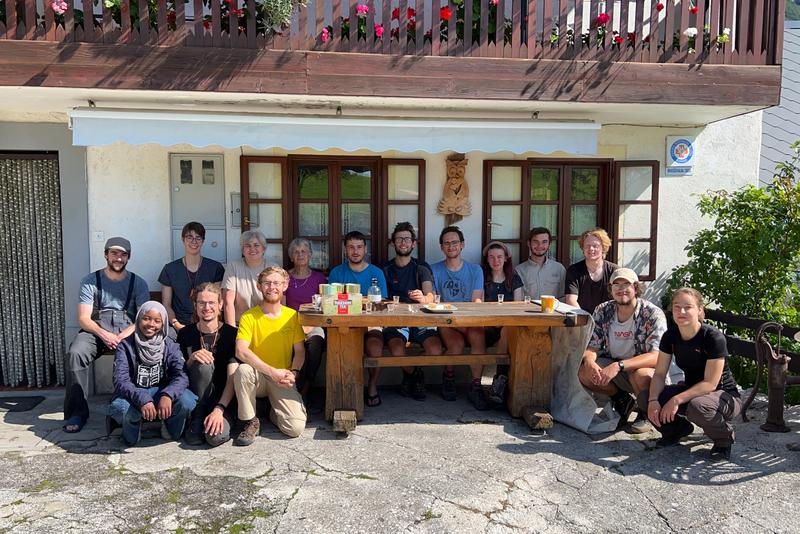
Despite ambitious goals, the 2025 expedition succeeded in its objectives. 11 cavers were introduced to alpine expeditionary caving, our first ever hammock camp was established at -700m (proving very popular), deep leads in Primadona were pushed and ongoing, and we concluded by dining with the British Ambassador to Slovenia.
Overview
The ambitious 2025 Migovec expedition proved to be a great success, with most of our objectives having been ticked off. Most importantly of all, 11 cavers were introduced to alpine expeditionary caving for the first time, a number considerably higher than recent years. While so many new faces on the mountain was a fantastic experience, it did bring with it a series of challenges; balancing leader ratios, pushing leads beyond depths accessible by novices, and the logistics of making sure everyone gets to, up, down and home from the mountain successfully and enjoyably. As if this wasn’t enough of a challenge, we also had set ourselves the goal of establishing a brand new style of camp never yet seen under the hollow mountain: hammocks.
Despite these challenges, the expedition successfully balanced training and exploration with 750 new meters surveyed. Exploration in recent years had focused on pushing from Hallelujah Camp, established in 2022. This branch of the system has grown considerably, and by the end of last year’s expedition the main discoveries lay a substantial distance beyond the camp. Most notably, a major breakthrough was made with the discovery of My Little Pitch, a dramatic 90 m drop appearing unexpectedly at the end of the horizontal Sparkle Highway passage. The expedition left the mountain in 2024 with three highly promising leads below this pitch, and considerable enthusiasm to return and push deeper. Progress was made on the major leads below My Little Pitch, extensive surveying was completed, and a wide range of members gained valuable expeditionary experience. The expedition leaves behind multiple exciting projects for future years, and a stronger and more experienced cohort of developing expedition cavers.
Primadona
A new camp
Last year's discovery of the enormous My Little Pitch left this year's pushing front far deeper than the current Hallelujah Camp can support - a new underground camp was required! The absence of flat surfaces, and the scarcity of water in that region of cave made the camp location and set up a topic of hot debate during the months leading up to the expedition. Portaledges were thoroughly considered, but hammocks were chosen instead for their greater portability, and lower cost. The system's air temperature is around 2 degrees and we worked hard to make the hammocks warm. A sleeping bag and warm liner is not enough as the layers compact, allowing drafts to steal heat from below. Roll mats can be used, only they move around and become uncomfortable. Instead, we settled on a custom underquilt design. Cheap rectangular sleeping bags were cut open at the bottom and modified to hang around the hammock and cinch at both ends. The success of Camp Sparkle could open up new possibilities for camps in other areas of the system that we would previously have ruled out.
Loompaland
Loompaland was pushed 200m this year in two trips, discovering 2-Loompa 2-Land and Loompaland: Tolmin drift. The phreatic continued in a downward crawl for another 15m before intersecting a larger, unexplored passage, before descending 20m into a large chamber. The phreatic continues below the chamber with a 3m diameter at the top, and a 2m vadose trench at the bottom. Tolmin Drift begins with a traverse over an undescended pitch, where the vadose trench leaves the phreatic, and continues steeply downwards to the only speleotherm ever discovered in this region of cave! The main has been left at a 15m pitch where surveys show a possible connection to Deveti Krog, a deep passage in the adjacent TTT branch.
Down the Rabbit Hole
Down the Rabbit Hole was visited once this year, where 44m were surveyed. A 10m pitch dropped into a rift with a false floor where the river disappeared below. The passage continued on this level for several meters, where the water re-emerges half way down a pitch. This pitch was carefully descended through the spray, earning the passage name: Alice in Waterland. The lead continues with walking passage towards empty mountain where it awaits a bold team, and dry weather.
Loosely Horsely
In Sparkle junction where we had our camp this year, a short up climb was completed last year, named Loosely Horsey. Above, a small streamway became Camp Sparkle's water source. This was followed upstream to a pool and a waterfall. Downstream, continues with another waterfall which is a very promising lead close to camp. This will be exciting to return to next year, especially as this is perhaps the continuation of the Hallelujah streamway - the higher camp's water source!
Blues and twos
A number of aid climbs were completed, the most notable of which was a 70m aven at around -700m, called ‘the big daddy’, which was the largest aid climb completed in the system in the last decade. The climb was completed in three pitches using big walling equipment: an adjustable fifi hook and Yates big wall ladders. This setup proved to be a great success, and proved to be far more efficient than using a bolting platform such as the Raumer stickup.
At the top of the first pitch is a promising lead: a short narrow tube at around 1.5m height, which can be easily crawled through to reach a wide open passage with a large waterfall at the far end. This is as of yet unexplored and remains an objective for next year's expedition. The very top of the 70m climb unfortunately didn't reveal any promising leads. However, completing the climb was a major milestone in terms of improving technical abilities and for gaining confidence in aid climbing underground.
Salome Viadlos
Salome Viadlos, long a place of myth within the club, was successfully rediscovered and re-explored this year. After many failed attempts over the past decade, a breakthrough was made when a team followed a small carbide arrow, leading via a series of bolt climbs and traverses to a vast series of chambers. The rediscovered section comprises approximately 360 m of enormous chambers, many tens of metres wide and up to 60–70 m tall, including three major chimneys first reported in the early 2000s.
Extensive geological deposits were found throughout the chambers, most notably slabs of mudstone and riverbed conglomerate near the roof of one aven, with breccia beneath suggesting a former water depth of 0.7–1 m. These findings were described by cave geologist Dr Tanguy Racine as “potentially huge” and may significantly alter current understanding of the system’s development and the ancient course of the Tolminka river.
A second team bolt climbed an overhanging wall where a traverse disappeared through drafting boulders. Survey data shows this region of cave is close to the surface, and the discovery of two bat carcasses encourages the belief of a nearby entrance. Completing this traverse, and potentially locating a new entrance, will be a major objective for the 2026 expedition.
M16
The large chamber which intersects level-2 and faulty towers in the old system (M16) has been the subject of a number of aid climbs over the last couple of years. This year, a largely free-hanging traverse was bolted leading to 20m aven, which was subsequently aid climbed. At the top of the climb is a rock bridge which overlooks the top of a different aven in the same chamber. Looking up from here is a short 2m climb, which is as of yet unascended, and is an extremely promising lead. The climb appears to be a small streamway which is the source of the majority of the water coming into the lower chamber. The top of the aven was called ‘don’t mention the water’, a play on ‘don't mention the war’ from Fawlty Towers. The primary motivation for aid climbing in M16 has been to explore the possibility of finding another entrance from the ground up, which could possibly increase the top height, and therefore overall depth of the system. Furthermore, the climbs in M16 have been a good training ground for bolt climbing, given their relative proximity to the surface.
Leads for next year
Right below My Little Pitch, is a 30cm slot between a boulder, and the pitch’s back wall. Throwing rocks suggests this second pitch could be 30-40m deep, extending the height of MLP to over 120m making it the largest in the system! Two trips have tried in vain to make it through the confined space. While progress is slow, enthusiasm is high for discovering Migovec's largest pitch.
Brezno Pod Vrhom Planje
At the end of last year there were two strong leads, with a going pitch head left at the end of the House of Cards branch, and numerous windows left unpushed in the Osmica branch. The lead down House of Cards remains the focal point of Planja efforts, both in 2025 and in the plans for 2026.
The Game of Stones pitch was discovered following Duckbuster, which was deemed safe to descend after a typically extended gardening session. The chamber has a few different branches off of it, including a nasty grabby crawl (mostly unexplored), however the major candidate was a short drop with some hanging death ending in a false floor. On a later trip, the hanging death and the false floor were both removed with hand tools, leading us down to a small seemingly choked chamber - A Feast for Krolls. However after some digging, which mostly consisted of moving one notable boulder the size of a small dog a safe distance away from the entrance to a tight squeeze, a caver can proceed through a slightly loose crawl which leads to a blind drop onto a boulder which hangs by unknown supports above a medium sized chamber. It is possible to skirt around the edge of the boulder to drop into the chamber, however some dedicated rigging in the crawl will be needed to make this safe. Needless to say this is planned to be one of the early pushing trips to Planja in 2026, once Café Crumble is restocked and the entrance rigging is complete.
One other interest to be investigated next year is the potential for window exploration down the fiercely sharp Osmica branch. Down One at a Chime there are a number of continuations which have potential to lead onwards, though due to the challenge of technical ability and fitness to reach the bottom of One at a Chime with time to spare and the far more promising lead in House of Cards, this may take second place in priority.
Surface Exploration
Abrax, Brabrax, Kalifax
Two new members to the expedition took the lead in exploring and surveying some newly discovered caves close to the nearby mountain hut, Razor. Three short caves were discovered (Abrax, Brabrax, Kalifax), and although these three ultimately died, they proved that there is great potential for development beyond the traditional hunting zone. Additionally, this was a great exercise in exploring and surveying for members who were new to such techniques.
The Goat Shelter
Although slightly after the main expedition had ended, the Slovene cavers made progress on a lead in the side of Kuk, known as The Goat Shelter, which seems to be drafting strongly but requires additional widening before a descent is possible. Excitingly, the altitude gain from this higher entrance would be enough to get the system over the symbolic one kilometre depth, so hopes are high that this new lead goes big in 2026.